Loading…
Service
Masonry Waterproofing
Penetrating sealers, below-grade membranes, and cementitious coatings for Chicago masonry buildings. Silane and siloxane systems specified for the substrate — not defaulted from a catalog. Tuckpointing and waterproofing under one contract.
Chicago Masonry & Water
Why Chicago Masonry Gets Wet
Mortar joints account for the majority of water entry through a masonry wall — not the brick itself. Chicago puts 80 to 100 freeze-thaw cycles a year on that wall, Lake Michigan keeps the east and north elevations loaded with wind-driven rain, and road salt chlorides climb six to ten feet above grade on splash-back. The top floor of a mid-rise takes up to twenty times the rain deposition of a sheltered low-rise — wind drives water horizontally at those heights, and standard gravity drainage assumptions stop working. Pre-1920 Chicago common brick is soft and absorptive, with saturation coefficients above 0.80. When that brick stays wet through a freeze cycle, the face pops off. Waterproofing isn't cosmetic maintenance. It's the difference between a sealer reapplication every seven to ten years and a full brick replacement scope.
What We Look For
We don't quote waterproofing until we know the mortar is sound. If the joints are cracked, recessed, or missing, sealing the brick face traps water behind the treatment and accelerates the damage — the sealer makes it worse, not better. We verify joint condition on every elevation, test substrate moisture content to confirm it's under five percent, and run RILEM tube absorption tests to establish a baseline before treatment and verify performance after. On buildings with active leaks or suspected moisture paths, we bring infrared thermography — wet masonry reads cooler from evaporative cooling, and a full-facade IR scan maps moisture patterns without exploratory demolition. Below grade, we core-test foundation walls for moisture content and check for hydrostatic conditions. Chicago's clay layer creates perched water tables as shallow as four to six feet near the river and lakefront.
How We Waterproof It
Above grade, we specify penetrating silane/siloxane sealers — they react inside the capillary pores, create a hydrophobic barrier within the substrate, and stay vapor-permeable so the wall can breathe. No appearance change, no film to peel. We match the chemistry to the substrate: silane blends for dense face brick, siloxane for porous CMU and split-face block, chloride-resistant formulations at grade level where road salt hits. Film-forming coatings — acrylics, urethanes, elastomerics — trap moisture inside the wall. On Chicago's pre-war soft brick, one winter behind a film-forming sealer can spall more faces than ten years without any treatment at all. We don't use them on exterior masonry in this climate. Below grade, the approach depends on access. Positive-side sheet membranes when we can excavate. Cementitious and crystalline systems from the interior when adjacent buildings or sidewalks block exterior access. The grade transition — where above-grade sealer meets below-grade membrane — is the most failure-prone detail on the building. We detail that joint as part of the scope, not as an afterthought.
Scope & Estimate
Above-grade penetrating sealer application runs $2 to $10 per square foot installed, depending on substrate porosity, access method, and product specification. Scaffolding or swing stage on a six-story building can equal or exceed the application cost — which is why combining tuckpointing and waterproofing in one mobilization saves real money. Below-grade membrane systems run $8 to $15 per square foot with excavation, $3 to $6 for cementitious coatings applied from the interior. Reapplication cycles for silane sealers run seven to ten years on vertical surfaces in Chicago climate — shorter on parapets, copings, and salt-splash zones. We build the maintenance schedule into the original scope so reapplication is budgeted, not forgotten. A simple splash test — pour water on the surface, see if it beads or absorbs — tells you whether the sealer is still active.
One Firm. Full Scope.
The most common waterproofing failure on masonry buildings isn't the sealer — it's sealing over mortar joints that should have been repointed first. When the tuckpointing contractor and the waterproofing contractor are different firms, nobody owns that gap. The repointer says the joints were sound when they left. The sealer says the joints failed after they applied. The building owner pays for both scopes again. We repoint the mortar, let it cure, verify the joints, and then apply the waterproofing — one crew, one contract, one accountability. When the sealer needs reapplication in seven to ten years, we inspect the joints at the same time. One mobilization, full scope.
Craftsmanship
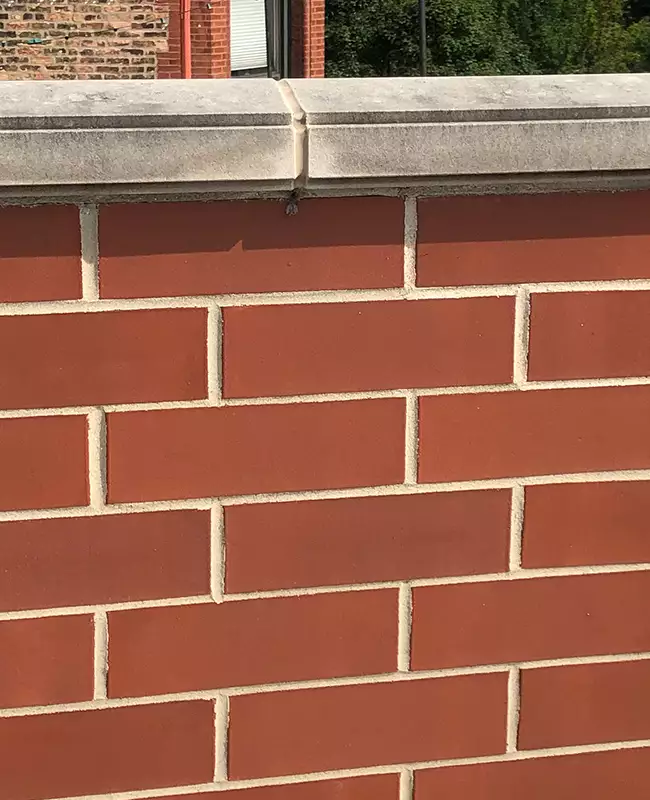
Sealed After Sound Repointing
Penetrating silane/siloxane sealer applied to freshly repointed masonry — joints verified sound, substrate moisture confirmed under five percent, sealer specified for the brick. No film, no appearance change, full vapor permeability. The wall breathes and sheds water at the same time.
Service Experts
Your Project
Team

Tom Bartosiewicz
Construction Principal
“Tom came up through heavy civil — roads, bridges, infrastructure — before turning that engineering discipline loose on Chicago's building stock. Three thousand projects later, he still walks every site before his crews touch it. Mortar joints, membrane failures, corroded lintels — he reads a facade the way most people read a blueprint. His team doesn't patch problems. They fix root causes.”
View Full Profile

Christi Malone
Building Inspector, Architect
“Christi is the firm's lead building inspector. She has been inspecting Chicago buildings since 2015 — facade condition assessments, structural evaluations, ordinance compliance reviews — after two decades practicing architecture. She holds a Master of Architecture from Arizona State and knows what failure looks like before it reaches the surface: the hairline crack that means embedded steel is corroding, the efflorescence that traces a moisture path, the mortar joint that's taken one too many Chicago winters. Her inspection reports are where every scope of work begins.”
View Full Profile

Darren Flynn
Managing Principal
“Darren started in construction and spent fifteen years on Chicago rooftops — steel, waterproofing, structural framing — learning every system in the building envelope from the top down. In 2009 he founded the firm. Today he runs a 60-person operation with in-house architects, engineers, and tradesmen, all under one contract. Twenty years in construction taught him one thing: if you're managing the building, you shouldn't have to manage the contractor too.”
View Full Profile